


Recently, the editors of Scientific American took a stand against the mandatory labeling of food products containing ingredients that have been genetically modified using biotech tools.
Their main arguments were that it would only increase the already widespread misconceptions about GM foods, lead to less consumer choice as companies want to avoid labels on their products that may decrease sales, increase food costs for the consumer, give farmers and manufacturers additional administrative work and further stigmatize beneficial technologies that have increased yields and profits for individual farmers and promises to combat deficiency diseases that blind and kill hundreds of thousands of children. I wrote a blog post about the backlash in the comment section to the Scientific American article, finding the arguments provided by anti-GMO activists to be misguided and inaccurate.
As predicted, the anti-GMO activists were not discouraged one bit by the Scientific American article and tried to drown out the science-based arguments showing that GM foods are stringently tested, heavily regulated and safe, both for human consumption and the environment. This occurred, among other places, on the Facebook page Skeptics; Atheists; Realists; Agnostics; Humanists when they shared the Scientific American article. Several anti-GMO activists and misguided bystanders swarmed down on in the comment section and started spreading what, at the time of this writing, added up to least twenty-four anti-GMO falsehoods. This article refutes most of them (although organized by topic as multiple falsehoods revolved around the same topics, such as safety or patents).
The intellectual dishonesty of the shill gambit
When you come across a claim that you disagree with, the rational approach is to provide arguments and evidence against it. People who do not have any tend to resort to a number of logical fallacies, cognitive simplifications or thought-terminating clichés. One such key example is the dismissal of any evidence or arguments in favor of genetically modified foods by deploying the shill gambit. In the context of Scientific American and genetically modified foods, this amounts to the bare assertion that some large corporation that deals with GM crops, seeds or foods (often Monsanto) must have paid them off to publish that article. This conveniently allows the reduction of cognitive dissonance without having to address any of the actual arguments.
Another related technique to group critics of anti-GMO activists together with large corporations uses the false dilemma fallacy: either you are with us, or you are against us; either you accept the anti-GMO rhetoric, or you are part of the problem.
Scientific consensus is a proxy for a mountain of evidence
Many large, scientific organizations have made statements supporting the safety and usage of genetically modified foods. This indicates that the scientific evidence strongly contradicts the anti-GMO position. In response, some anti-GMO activists claim that “science has been wrong before” and cite the case of asbestos. However, there was never a time when the scientific consensus position, backed up with hundreds of safety studies, was that asbestos was safe. Ironically, this anti-GMO assertion resembles similar claims made by creationists, suggesting that there is a set of common tactics used by a wide range of different kinds of denialists.
GM foods are as safe as conventional foods
No conventional food product is 100% risk-free and safe. Conventional potatoes contain small amounts of solanine, a glycoalkaloid poison that can cause neurological disorders and death. Peanut butter can be contaminated with aflatoxin, which can cause necrosis of the liver and liver cancer. This does not mean that conventional potatoes and peanut butter are dangerous to your health. The concentrations involved are usually too low to cause any negative health effects.
Regulation of genetically modified foods has focused partly on what is known as substantial equivalence. This means that if a GM food item is at least as safe as a conventional counterpart (as shown by safety assessment studies), then this is evidence for the safety of that GM food item. The World Health Organization describes those safety assessments as follows (WHO, 2013):
The safety assessment of GM foods generally investigates: (a) direct health effects (toxicity), (b) tendencies to provoke allergic reaction (allergenicity); (c) specific components thought to have nutritional or toxic properties; (d) the stability of the inserted gene; (e) nutritional effects associated with genetic modification; and (f) any unintended effects which could result from the gene insertion.
This does not mean that the genetically modified food item and the conventional counterpart are genetically unique, just that the GM food item is not more dangerous than the corresponding conventional food item.
On the safety of genetically modified foods, the WHO has this to say:
GM foods currently available on the international market have passed risk assessments and are not likely to present risks for human health. In addition, no effects on human health have been shown as a result of the consumption of such foods by the general population in the countries where they have been approved.
[…]
The GM products that are currently on the international market have all passed risk assessments conducted by national authorities. These different assessments in general follow the same basic principles, including an assessment of environmental and human health risk. These assessments are thorough, they have not indicated any risk to human health.
What about long-term studies? A systematic review of published studies looking at the long-term and multi-generational effects of various kinds of genetically modified foods was published recently. Snell et al. (2012) found that “GM plants are nutritionally equivalent to their non-GM counterparts and can be safely used in food and feed”.
In total, there have been around 600 published safety studies of genetically modified foods and at least 130 of these studies were funded completely independently of biotech companies (Biology Fortified, 2013).
Follow Debunking Denialism on Facebook or Twitter for new updates.
Farmers can still buy, trade or save conventional seeds
Farmers can freely buy conventional seeds from seed companies, participate in the legal trading of seeds and even save conventional seeds from their harvest. No one is forcing farmers to buy genetically modified seeds. If farmers want the added benefits of growing genetically modified crops, then they have to follow the legal requirements of that contract, such as not saving the GM seeds. Companies that develop GM varieties are not patenting basic foods, just their GM variety. Even new conventional crops come with a version of a patent called plant variety rights. This enables the developer to license it and those that violate that license can be sued in court.
For some conventional plants, many farmers may even prefer to buy new seeds than save seeds from the previous harvest. This is because many hybrid plants provide larger yields than the first generation plants from those hybrids.
Also, this line of argument is not related to the safety of genetically modified foods, but about the actions of certain corporations. Therefore, even if true, it would not by an argument against GM foods.
GM crops use less insecticide
The following image is from a National Research Council report entitled “Impact of Genetically Engineered Crops on Farm Sustainability in the United States” (National Research Council, 2010, p. 28):
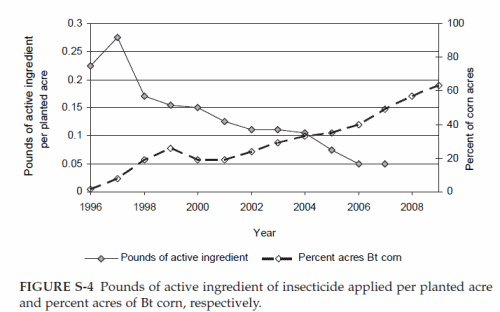

As the adoption of GM corn has increased, the amount of insecticides used has decreased. This shows that GM crops do not require more insecticides.
GM crops has led to the use of less dangerous herbicides
The increase in acres planted with plants resistant to the herbicide glyphosate has of course increased the use of glyphosate. However, this has decreased the use of other herbicides that are much more toxic. According to the National Research Council (2010, pp. 24-25):
When adopting GE herbicide-resistant (HR) crops, farmers mainly substituted the herbicide glyphosate for more toxic herbicides. However, the predominant reliance on glyphosate is now reducing the effectiveness of this weed-management tool. Glyphosate kills most plants without substantial adverse effects on animals or on soil and water quality, unlike other classes of herbicides. It is also the herbicide to which most HR crops are resistant. After the commercialization of HR crops, farmers replaced many other herbicides with glyphosate applications after crops emerged from the soil.
Here is the accompanying graph:


In other words, while more glyphosate is being used, this practice has reduced the usage of much more toxic herbicides.
GMO bans are driven by lobbyists who spread fear and misinformation
Some countries have banned GMOs. However, this has not been done because the evidence somehow shows that GM foods are dangerous, but because of political lobbyists. As was pointed out in the comment section on Facebook, the fact that countries have banned something is not a viable argument. Many countries have a ban on same-sex marriage, yet even the most ardent anti-GMO activist would probably understand that such a claim cannot constitute an argument against same-sex marriage.
Bt corn safe for human consumption because the Bt toxin is highly specific
For many decades, conventional and organic farmers have sprayed their crops with a bacterial solution containing Bacillus thuringiensis without any safety issues. These bacteria produce a toxin that kills a certain very specific range of harmful insects leaving other animals and humans unharmed. To make this method more efficient and less time-consuming, researchers inserted the gene for this toxin into the plant itself, so now the plant produces the toxin.
The key to this high specificity lies in the fact that three distinct criteria need to be fulfilled before the toxin can have any harmful effects. The stomach environment needs to be alkaline (humans have acidic) to dissolve the aggregate of inactive precursors, a specific protease needs to be there to cleave the precursor into the active form of the toxin (humans do not have it) and there needs to exist a specific receptor on the stomach lining so that the toxin can have its lethal effects (humans lack this receptor).
We have already seen that GM foods currently available, including Bt corn, do not have any negative health impacts on humans. However, anti-GMO activists still think that a plant producing its own toxin is dangerous to humans. It is not, because humans do not have any of the three key requirements needed for the toxin to be dangerous.
Health benefits of genetically modified foods
The second generation of Golden Rice has 31 micrograms of beta carotene per gram rice (Paine et al., 2005). Right now, 250 million children suffer from vitamin A deficiency, up to half a million go blind and up to a quarter of a million die each year (WHO, 2013). To prevent vitamin A deficiency, a child in a developing country needs only eat around 70g of Golden Rice per day (Paine et al., 2005). To say that there are no health benefits with genetically modified foods is the summit of ignorance.
GM crops do increase yield
According to Herrera-Estrella (2000), growing plants resistant to herbicides, viruses and insects resulted in a 5-10% increase in yield (saving 40% of herbicide costs and up to 120 USD per acre in insecticide costs) as early as 1996-1997. Indian farmers growing Bt cotton have used around 40% less pesticides, gotten an average of 37% yield increase and almost 90% higher cotton profits (Qaim et al., 2009).
The myth that GM crops do not increase yield comes from a report from the non-governmental organization Union for Concerned Scientists. They looked at the intrinsic yield (comparable to the number of kernels on a cob) and concluded that it has not improved. However, this is not the most relevant way to measure yield to a farmer. Instead, a farmer cares about the total mass of maize that you can get out from the same input. As we have seen, the total yield has indeed increased by adopting GM crops.
Topsoil erosion is reduced because GM crops facilitate no-tillage farming
Conventional agriculture usually removes weeds by plowing. However, this method leads to erosion of top soil and the release of additional carbon dioxide. When using herbicide resistant plants, no such plowing to remove weeds is necessary. That means that GM crops that are herbicide-resistant reduce topsoil erosion. The adoption of herbicide-resistant crops facilitate no-tillage farming and no-tillage farming facilitate the adoption of herbicide-resistant crops (Fernandez-Cornejo et al., 2013).
In fact, a study by the American Soybean Association (2001) showed that over half of all farmers adopted reduced tillage farming because of the introduction of herbicide-resistant soybeans.
Golden Rice and virus-resistant papaya were not developed for profit
Golden Rice was developed to combat vitamin A deficiency that makes half a million children go blind each year and kills nearly half of them. The patents were negotiated away in order to provide Golden Rice seeds free of charge to poor African farmers. Current research into Golden Rice is largely being funded by the Bill and Melinda Gates Foundation.
In the 1990s, the papaya ringspot virus (PRSV) nearly wiped out the entire papaya industry in Hawaii. Scientists responded by producing papaya versions that were resistant to that virus using biotechnological tools. This research was funded by a USDA grant program and was not done for profit.
These two examples highlight the problem with the assertion that all GM products are created for profit.
Only 1 out of 28 people in the leadership of FDA has any prior connection to Monsanto
A common claim is that the FDA is secretly run by former employees at Monsanto, thereby undermining the credibility of FDA assessments of genetically modified foods. However, upon closer inspection, only a single individual (Michael R. Taylor) has any potential ties to Monsanto. However, Taylor has previously had a number of high-level positions both at the FDA and USDA and has also served on many expert committees for the National Academy of Sciences (FDA, 2013). Far from being some shadowy Monsanto double agent, Taylor is a recognized world-leading expert on food safety. To be sure, conflicts of interest are a problem, but it is a huge disservice to food safety to twist the facts the way that anti-GMO activists do on this issue.
The Farmer Assurance Provision protects farmers
This provision, signed into law in early 2013, allows farmers to keep growing GM crops that have been approved by USDA even if legal challenges are made with regards to their safety. This means that activists cannot hijack the legal system to force farmers to destroy their GM crops. It protects the food supply from disruptions caused by litigation over procedural issues. Condescendingly called Monsanto Protection Act by anti-GMO activists, this provision will last until the end of September of 2013 (Snopes, 2013).
Hazmat suit on GM fields: used by anti-GMO activists (not researchers) to spread fear
In July of 2011, anti-GMO activists dressed up in Hazmat suits destroyed field trials of genetically modified wheat at CSIRO (the national science agency in Australia) facility in Canberra. They caused damage for around 300 000 USD and set back research at least a year. According to Jeremy Burdon, the industry plant chief, Hazmat suits are not worn by researchers working on GM field trials because there are no hazards there. Researchers working with the genetically modified wheat call the Hazmat suits “theatrical” and a “publicity stunt, designed to mislead the public and spread unwarranted fear” (Bettles, 2011).
Conclusion
A massive amount of scientific evidence shows that the GM foods currently available on the international market are just as safe as conventional foods. Farmers can still buy, trade or save conventional seeds. GM crops require less insecticide and use less harmful herbicides. GMO bans are driven by lobbyists who spread fear and misinformation. As early as the late 1990s, GM crops had a 5-10% increase in yield. Indian farmers growing Bt cotton use ~40% less pesticides, get ~37% yield increase and almost 90% higher cotton profits. GM crops reduce topsoil erosion because they promote reduced tillage. Many GM crops, like Golden Rice and PRSV-resistant papaya were not developed for profit. Only 1 out of 28 people in the Leadership of FDA has any prior connection to Monsanto and the Farmer Assurance Provision protects farmers (and is even about to expire). Hazmat suits are not used by researchers on GM fields. It was just a publicity stunt by anti-GMO activists to spread fear.
References
American Soybean Association (2001). ASA Study Confirms Environmental Benefits of Biotech Soybeans. Accessed: 2013-08-25.
Bettles, C. (2011). Greenpeace GM wheat Hazmat suits ‘theatre’. The Land. Accessed: 2013-08-24 (webcite).
Biology Fortified. (2013). Studies for GENERA. Accessed: 2013-08-25.
FDA. (2013). Meet Michael R. Taylor, J.D., Deputy Commissioner for Foods and Veterinary Medicine. Accessed: 2013-08-25.
Fernandez-Cornejo, J., Hallahan, C., Nehring, R., Wechsler, S., & Grube, A. (2012). Conservation tillage, herbicide use, and genetically engineered crops in the United States: The case of soybeans. AgBioForum, 15(3), 231-241.
Herrera-Estrella, Luis R. (2000). Genetically Modified Crops and Developing Countries. Plant Physiology, 124(3), 923-926. doi: 10.1104/pp.124.3.923
National Research Council. (2010). Impact of Genetically Engineered Crops on Farm Sustainability in the United States. Washington, D. C.: National Academy Press.
Paine, Jacqueline A., Shipton, Catherine A., Chaggar, Sunandha, Howells, Rhian M., Kennedy, Mike J., Vernon, Gareth, . . . Drake, Rachel. (2005). Improving the nutritional value of Golden Rice through increased pro-vitamin A content. Nat Biotech, 23(4), 482-487.
Qaim, Matin, Subramanian, Arjunan, & Sadashivappa, Prakash. (2009). Commercialized GM crops and yield. Nat Biotech, 27(9), 803-804. doi: 10.1038/nbt0909-803b
Snell, Chelsea, Bernheim, Aude, Bergé, Jean-Baptiste, Kuntz, Marcel, Pascal, Gérard, Paris, Alain, & Ricroch, Agnès E. (2012). Assessment of the health impact of GM plant diets in long-term and multigenerational animal feeding trials: A literature review. Food and Chemical Toxicology, 50(3–4), 1134-1148.
Snopes. (2013). Monsanto Protection Act. Accessed: 2013-08-25.
WHO. (2013). 20 questions on genetically modified foods. World Health Organization. Accessed: 2013-08-25.
WHO. (2013). Micronutrient deficiencies: Vitamin A deficiency. Accessed: 2013-08-25.