


Over a year ago, statistician Nassim Nicholas Taleb co-wrote an ignorant paper on the precautionary principle and its supposed lethal application to genetically modified foods. In it, the authors made several errors. They asserted, without evidence, that genetically modified crops are more dangerous than conventional crops and failing to consider the benefits of GM crops in preventing vitamin a deficiency, blindness and death (instead falsely comparing it to letting poor people play Russian roulette to get out of poverty).
Despite critics writing several detailed refutations, Taleb retained the irrational belief that no “intelligent comment” had been made. A person even tweeted Taleb the above article from Debunking Denialism and after spending a total of two minutes on it, Taleb declared that it was “not very intelligent”, “full of flaws” and “even downright stupid”, despite the fact that it had demolished the central claims made by the authors.
As if this was not enough, Taleb has now gone full-blown anti-science. In a couple of recent tweets, he went so far as to defend homeopathy at length. He falsely claimed that homeopathy was harmless and thus totally ignoring documented expectancy side-effects as well as the problem that people with real dangerous medical conditions (such as cancer) might avoid science-based intervention. He also completely misunderstood and mocked the psychiatric condition known as health anxiety, thereby implying that those individuals are better of with homeopathy than psychotherapy. In a final twist of incomprehensible absurdity, Taleb stated that superstitions such as homeopathy can sometimes be rational, particularly if they somehow “prevent you from listening to forecasts by economists”.
Homeopathy is not “harmless placebo”
Taleb starts out by making the common claim that homeopathy is harmless:


Homeopathy is not harmless. It is certainly pharmacologically inert on its own, but this is not the same as harmless. First, promoting homeopathy might make people with dangerous medical conditions forgo science-based treatments. Second, homeopathy can be accompanied by negative expectancy effects called nocebo effects. Third, unscrupulous alternative medicine sellers can mix in pharmacologically active substances that can have potentially dangerous health consequences. In the United States, all of this is unregulated by the Food and Drug Administration (FDA).
Taleb also claims, without any evidence, that homeopathy can prevent over-treatment and iatrogenic damage. A quick search on PubMed for “homeopathy iatrogenic” reveals a total of 8 papers. 5 papers are published in the journal Homeopathy, 1 is a criticism of homeopathy written by Edzard Ernst that questions the belief that homeopathy is risk-free and the remaining 2 papers are surveys on how homeopaths view themselves and where homeopathic centers are located and what they attempt to “treat”. A similar disappointment is found when searching for “homeopathy overtreatment”, resulting in only a single paper that claims that homeopathy is cost-effective. This conclusion was contradicted by a 2015 paper in PLoS One that looked at almost 45 000 patients, which showed that additional treatment with homeopathy led to more productivity loss, higher outpatient care costs and larger over all cost.
Follow Debunking Denialism on Facebook or Twitter for new updates.
Superstitions are not rational
Taleb continues his ignorant defense of homeopathy, this time going so far as to claim that superstitions “can be rational”:
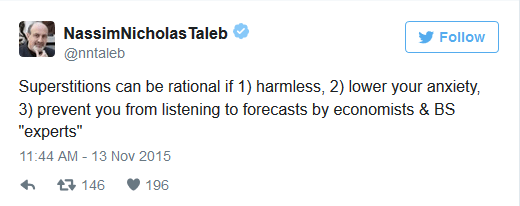

As we saw above, homeopathy is not harmless. The second argument provided by Taleb is that superstitions can be rational if they reduce anxiety. Yet this leads to an interesting contradiction: if alternative medicine “reduces anxiety”, then so to must science-based medicine since the latter actually treats medical conditions. So if both real medicine and quackery “reduce anxiety”, then, according to Taleb, both X and ~X must be rational. This makes precious little sense. It must also be pointed out that since alternative medicine probably does not reduce anxiety in any practically significant way, it is a false hope that prevents people from seeking effective treatment for anxiety.
His rant about how superstitions such as homeopathy is rational if it dissuades people from listening to economists and other “experts” is too incoherent to address.
Taleb does not understand health anxiety
A person on twitter replied to Taleb suggesting that people who use homeopathy use more medication, perhaps alluding to the PLoS One paper mentioned above that showed that homeopathy was not cost-effective. How does Taleb respond?


He completely denies it. The key point that Taleb is missing is that people with health anxiety do have a serious medical issue: health anxiety. They deserve to receive science-based treatment for this condition, such as psychotherapy, instead of being dismissed and offered homeopathy and lies.
Conclusion:
Previously, Taleb had contained his anti-scientific nonsense within the field of genetically modified crops and food. Now, he has broken all boundaries and started defending homeopathy. He thinks homeopathy is harmless, even though it can dissuade people from science-based treatments, may have harmful nocebo effects and may contain contaminants from active ingredients. He claims, without any evidence, that homeopathy reduces overtreatment or adverse events. Taleb even goes so far as to claim that superstitions can be rational. Although Taleb has made useful contributions to the analysis of risk, his claims about GMOs and homeopathy are disastrously wrong.