


The mainstream scientific community, specific science organizations and the scientific literature converge on the conclusion that genetically modified foods are safe for human consumption (European Commission, 2010; National Research Council, 2004; AAAS Board of Directors, 2012; WHO, 2013; Ronald, 2011). However, anti-GMO zealots oppose genetically modified foods for a variety of ideological reasons. They attempt to prop up their pseudoscientific beliefs by dressing up their assertions and make them appear scientifically credible. However, most of these anti-GMO arguments are either based on flawed research or relate to things that are not specifically related to GMOs. Sometimes the assertions consists of little more than fear-mongering based on myths.
There is a popular anti-GMO message that is making its way across the Internet in various forms. It contains five claims that allegedly support the notion that GMOs are “a recipe for global famine”. This post critically investigates these five claims.
As we shall see, they turn out to not be scientifically accurate. Farmers do not have to use seeds from GM crops, they can buy seeds from companies that deal in traditional plant breeding, they can save their own seeds and they can trade seeds between themselves. GM crops require less harmful chemicals than conventional agriculture and is therefore safer for humans and the environment. Monoculture originated on a large-scale in the Green Revolution and is not specific for GM crops. Scientists are currently developing plants that are more resistant to pathogens and there are large seeds banks with hundreds of thousands of different seed samples that ensures that we maintain biodiversity. Terminator technology was originally used for self-fertilizing plants (thus make it impossible to “spread sterility”), was abandoned in the late 1990s and replaced by legal contracts. GM crops does not entail the dependence on a centralized food system (golden rice is going to be distributed to individual farmers) and centralized food system helps to avoid harmful effects of crop failure. In the end, GM agriculture is probably necessary for future food security and environmental sustainability.
The first claim is about seed patents.
Fact: Farmers are not forced to by GM seeds
Patented Seeds: farmers growing GMO crops are denied their traditional right to save seeds for next year. If biotech fails suddenly, they will be unable to replant.
First of all, just because something is traditional does not mean that it is reasonable. For instance, female genital mutilation is a tradition in some parts of the world, but few rational people would therefore defend it.
Second, no one is forcing farmers to by GM seeds. If they want, they can buy seeds from companies dealing with conventional seeds, buy or trade seeds from other farmers, use their saved seeds from their conventional crops and so on. However, if a farmer wants to privilege of being able to use GM seeds, then he or she must following the requirements of the seller. If those terms are unacceptable, then don’t buy GM seeds from that company.
Third, conventional crops come with something called plant variety rights. This is roughly analogous to a patent and gives the person who developed a new conventional variety the right to license the variety to others (and violations of that right can be legally penalized). Although differences exists, this goes to show that even conventional agriculture is not free from entities similar to patents.
Follow Debunking Denialism on Facebook or Twitter for new updates.
As we will see below, this point (i.e. farmers are not allowed to save the functioning seeds they buy from GM seed companies) contradicts the claim about terminator seeds (i.e. farmers can’t save the seeds because they will not germinate).
Fact: GM crops require less harmful chemicals than conventional agriculture
Soil infertility: GMO agriculture is chemically intensive. Agrochemical buildup is causing sterility in the soil. Glyphosate herbicide is especially problematic.
In reality, the introduction of GM crops has coincided with the reduced usage of harmful pesticides and the reduction usage of more dangerous herbicides. This is the case for all three major GM crops: cotton, soybean and corn. Here is what the National Research Council report entitled “Impact of Genetically Engineered Crops on Farm Sustainability in the United States” (National Research Council, 2010, pp. 24-25) has to say:
Environmental Effects
Generally, GE crops have had fewer adverse effects on the environment than non-GE crops produced conventionally. The use of pesticides with toxicity to nontarget organisms or with greater persistence in soil and waterways has typically been lower in GE fields than in non-GE, nonorganic fields. However, farmer practices may be reducing the utility of some GE traits as pest-management tools and increasing the likelihood of a return to more environmentally damaging practices.
Finding 1. When adopting GE herbicide-resistant (HR) crops, farmers mainly substituted the herbicide glyphosate for more toxic herbicides. However, the predominant reliance on glyphosate is now reducing the effectiveness of this weed-management tool.
Glyphosate kills most plants without substantial adverse effects on animals or on soil and water quality, unlike other classes of herbicides. It is also the herbicide to which most HR crops are resistant. After the commercialization of HR crops, farmers replaced many other herbicides with glyphosate applications after crops emerged from the soil.
In other words, the use of harmful pesticides on GM crops is less than conventional crops and farmers has replaced more toxic herbicides with the less harmful herbicide glyphosate. Glyphosate also does not have any adverse effects on animals or the quality of soil and water. The report included this descriptive graphs (it also has graphs for cotton and corn that converge on the same message):


You can find anti-GMO claims online that the use of herbicides have increased due to GM crops but this is measured in amount per year and not amount per area grown crops. While it is true that glyphosate use has increased, there has been a large decrease in the use of more dangerous pesticides and herbicides. Just to drive the point home, here is the graph (p. 28) showing the reduction in insecticide after the introduction of BT corn.
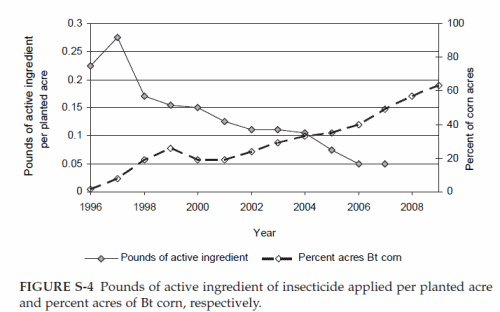

This means that the net result are large benefits in terms of human health and environmental safety.
Fact: Conventional agriculture created monocultures and GM technologies help combat it
Monocropping/Loss of Biodiversity: GMO agriculture is monocropping. 75% of seed diversity has already been lost to industrial farming. The Irish potato famine was the result of monocropping. Biodiversity is food security.
The agricultural problem of monoculture has to do with little genetic variation between plants as a result of strong classical plant breeding. This means that every plant will have a similar level of susceptibility to pathogens and entire crops can be wiped out by a single pathogen. In polyculture, there is a lot of genetic variation between plants so even if some plants would be susceptible to a particular pathogen, many others would not and so the entire crop will not get destroyed.
Widespread adaptation of monoculture occurred during the Green Revolution, which was the period during chiefly the 50s and 60s that lead to the doubling or tripling of global yield using nitrogen fertilizers and improved conventional selection techniques. In other words, monoculture is not a result of the introduction of GM crops. The originator of this list of claims seems to be aware of this when he or she writes that monoculture caused the Irish Potato Famine. This occurred around 1850 and killed around 1 million Irish and led to mass emigration of around 1 million more. Obviously, modern GM crops were not around in the mid 1800s.
Scientists have been researching ways to improve disease resistance in plants. One very successful example is that of papaya. In the 1990s, the papaya ringspot virus (PRV) almost annihilated the papaya industry in Hawaii. Researchers responded by genetically modifying the papaya so that it could successfully fight off the infection that it previously highly susceptible to. This saved the papaya production of Hawaii and today most of the papayas you eat are genetically modified.
Another way to ensure that we keep biodiversity is by using gene banks and seed banks. One of the largest seed banks in the world, Svalbard Global Seed Vault, contains around three-quarters of a million distinct seed samples. It is also worth pointing out that the loss of biodiversity was also the result of the Green Revolution, not GM agriculture.
Fact: Terminator technology has been terminated
Terminator Seed Technology: this is designed to genetically switch off a plant’s ability to germinate a second time. Plants with terminator genes can cross-pollinate with natural varieties causing otherwise fertile seeds to be sterile
In reality, terminator technology is not used in commercial GM crops at all (Slater, Scott, & Fowler, 2008). This is because Monsanto pledged way back in 1999 that they would not commercialize it (Vidal, 1999). In addition, those plants that were under consideration for having transgenic terminator technology was self-pollinating (Slater, Scott, & Fowler, 2008). That excludes the possibility of the nightmare scenario depicted above. Finally, many crops used in modern agriculture are so different from their wild relatives that they could not cross with them at all, even if terminator technology was used.
This argument also contradicts the first claim that farmers were not allowed to save their the functioning seeds from their crops.
Fact: GM crops does not mean dependence on a centralized food system
Dependency on a centralized food system: a network of home gardens, and small to midsized farms offer far greater food security than a centralized, global system. The bigger they are, the harder they fall. Think global, eat local.
I found this objection very peculiar since it has nothing to do with GM crops. There is no contradiction in having small to midsized farms that grow GM crop. Indeed, the very reason that the dozens and dozens of intellectual property rights for Golden Rice was negotiated away is to be able to distribute it to individual farmers.
Presumably, this “argument” against GMOs is based on some kind of environmentalist ideology based on a deep desire to return to a time where people were lived on farms and were self-sufficient and did not rely on corporations for food. This, of course, is misguided as some of the worst famines in the history of humanity occurred during those times (see earlier discussion about the Irish potato famine).
However, the notion of home gardens and smaller farms is not sustainable in our modern world. They do reduce environmental effects due to less transportation, but the system would be horribly inefficient and could probably not provide enough food for people living in large urban centers. It would also require sizable proportion of the population to change their jobs and start working in the agricultural sector, which is something that not everyone might want.
At any rate, this is not an argument against GM technology or GM crops.
Conclusion:
Farmers are not forced to buy GM seeds in the first place and if they do, then they should follow the requirements for that purchase. GM crops requires less dangerous pesticides and dangerous herbicides (even though the use of Glyphosate has increased). Monoculture was a problem that was created by the Green Revolution and GM researchers are currently working on improving the natural resistance of plants to pathogens. Terminator technology is not used commercially and GM crops do not depend on a centralized food system.
This post shows that common assertions made by anti-GMO activists are not based on any credible scientific data. In fact, it seems more like arguments against conventional farming (and in favor ecological farming) than arguments against GM crops specifically.
References:
AAAS Board of Directors (2012). Statement by the AAAS Board of Directors On Labeling of Genetically Modified Foods. Accessed: 2013-07-01.
European Commission. (2010). A Decade of EU-Funded GMO Research (2001-2010). Luxembourg: Publications Office of the European Union.
National Research Council. (2004). Safety of Genetically Engineered Foods: Approaches to Assessing Unintended Health Effects. Washington D. C.: The National Academy Press.
National Research Council. (2010). Impact of Genetically Engineered Crops on Farm Sustainability in the United States. Washington, D. C.: National Academy Press.
Ronald, Pamela. (2011). Plant Genetics, Sustainable Agriculture and Global Food Security. Genetics, 188(1), 11-20. doi: 10.1534/genetics.111.128553
Slater, A., Scott, N. W., Fowler, M. R. (2008). Plant Biotechnology: the genetic manipulation of plants (2nd edition). New York: Oxford University Press.
Vidal, J. (1999). World braced for terminator 2. The Guardian. Accessed: 2013-07-03 (WebCite).
WHO. (2013). 20 questions on genetically modified foods. Accessed: 2013-07-01.